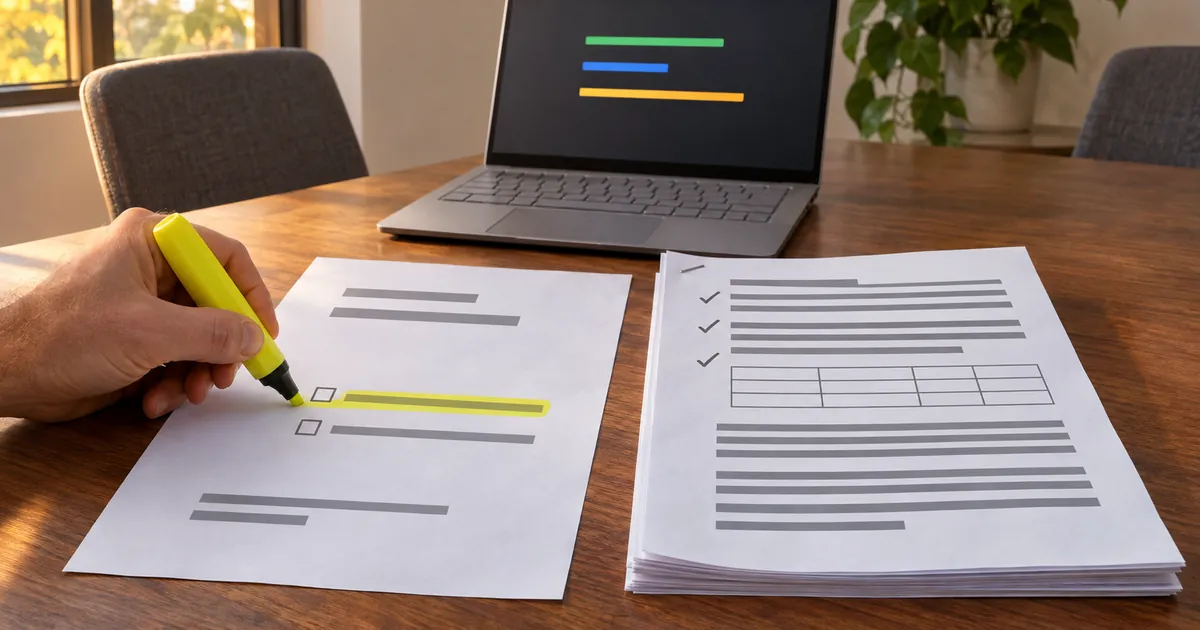
Line the quotes up on the same seven questions before you look at the price: what is in scope, how many tester-days, who tests, which method, what the report contains, whether a retest is included and what is excluded. Price per tester-day means something only once those lines match. A quote that can't say who tests, or for how long, may be a scan.
This guide is for the step after the quotes arrive. Price ranges and UK day rates live in our penetration testing cost guide. We also sell black-box penetration testing, so our own quote terms appear below as an example, including the tier that is only a scan.
What should a penetration testing quote include?
Enough for you to check the work before it starts. The UK National Cyber Security Centre says scoping should end in a document stating the technical boundaries, the types of test, compliance and reporting requirements, and the effort, "usually given in terms of resource days". If a quote leaves any of those out, ask for it in writing.
Turn that into a worksheet. Copy the rows into a spreadsheet and give each quote a column.
Line | A usable answer looks like | Ask this if it's missing |
|---|---|---|
Scope | Named URLs, API base paths, IP addresses, cloud accounts and app builds, plus the user roles to be tested | Which hosts and roles does this price cover? |
Effort | Tester-days, split by target if there is more than one | How many days, and how many of them are manual testing? |
Test basis | Black, grey or white box, with a test account per role for grey box | Will you log in, and as whom? |
Who tests | A named lead tester and their qualifications | Who does the work, and were they on the scoping call? |
Methodology | A documented method you can read, for web apps often mapped to the OWASP Web Security Testing Guide | Can we see your methodology document? |
Report | A redacted sample report attached to the quote | Can we see a sample before we sign? |
Retest | Included or priced, with rounds, severities covered and a deadline | What does a retest cost, and by when must we fix? |
Exclusions and conditions | What won't be tested, testing hours, staging or production, a contact on your side | What won't you test, and what do you need from us? |
The "who tests" row matters more than it looks. The NCSC says the quality of a test "is closely linked to the abilities of the penetration testers involved", because a test can't be fully scripted in advance. CREST's procurement guide for Australia and New Zealand gives buyers the same instruction from the other end: "Request evidence of methodologies, reporting standards, and retesting processes."
How do you compare two quotes side by side?
Normalise them first. Write each quote into the worksheet, send each vendor its blank lines, then divide each total by its tester-days. The example below uses two invented quote structures, with no prices, to show what that looks like when one vendor sends a fixed fee for a domain and the other sends a scope with days.
Line | Quote A (example) | Quote B (example) |
|---|---|---|
Scope | "Web application penetration test" for the main domain | Customer portal and its API on two named hosts; three roles: visitor, customer, admin |
Effort | Fixed fee, no days stated | Five tester-days: four testing the portal and API, one writing the report |
Test basis | Not stated | Grey box; you create one account per role before day one |
Who tests | "Our certified team" | Named lead tester, certifications listed |
Methodology | "Automated and manual testing" | In-house method document, mapped to the OWASP testing guide |
Report | Due the day after testing; no sample offered | Redacted sample attached: summary, risk rating per finding, reproduction steps, fixes |
Retest | Not mentioned | One round for High and Critical findings within 30 days, included |
Exclusions | None listed | Denial of service, phishing and the third-party payment page |
Quote A might be a good test. You can't tell yet. Send it back with the empty lines filled in as questions, and ask for days. Once both quotes have days, divide each total by them and compare the result with the day-rate bands in the cost guide.
If one vendor can't give a day count at all, or the "test" finishes in hours, ask straight out whether you are buying an automated scan.
How can you tell if a quote is really a vulnerability scan?
Look at what the vendor asked before quoting. A scan can be priced from a domain name, while a manual test has to know the roles, flows and hosts. If nobody asked about logins, nobody is planning to test behind them. Ask which findings a person will try to exploit by hand, and get the answer in the quote.
A buyer's guide that CREST published with its penetration testing focus group draws the line clearly. A vulnerability assessment "involves the use of automated techniques to map, scan, and identify security vulnerabilities", while a penetration test combines automated and manual techniques "to identify and exploit known and unknown vulnerabilities" (CREST buyer's guide, part 1). Both are useful. They are different purchases, and our comparison of penetration testing and vulnerability scanning covers what each one finds.
Our own cheapest tier shows the honest version. Lite, at $250, is "a vulnerability scan and summary report", and our penetration testing page sells it as exactly that. Plus and the tiers above it add manual testing. If a vendor's cheapest "penetration test" reads like our Lite, ask which one it is.
What does CREST on a quote actually tell you?
That depends on whether the company or the person holds it. CREST accredits companies and, separately, certifies individual testers, and a quote can mention either. Ask whether the firm is a current member for penetration testing specifically, and whether the person on your job holds a current certification. Then check the answers yourself.
CREST's own procurement checklist opens with that question: "Is the organisation a current CREST (International) Member for the relevant service(s)?" It then asks whether personnel "hold current CREST (International) certifications or equivalent".
If a quote offers a CREST Defensible Penetration Test, the CDPT specification sets a minimum for the report. It should cover the scope with any exclusions and the coverage gained, a timeline of key activities, enough detail for you to replicate each issue, a severity rating for every vulnerability, "a statement of totality against the defined scope", and the CREST IDs of the people who scoped and delivered the test. You can check all of those on a sample report.
Whether you need CREST at all is a contract question, covered in the CREST and CHECK section of our pen test pricing guide. CHECK is narrower: the NCSC describes it as the scheme for authorised testing of public sector and CNI systems. Our own service page says it "does not claim CREST or CHECK status for OVERLORD Team LTD". If your contract names an accredited provider, that rules us out, and the same check applies to every quote on your desk.
What should the sample report show?
Findings you could hand to a developer the next morning. The NCSC lists what a test report should contain: the issues found, the team's risk rating for each, a way to resolve each one, an opinion on how accurate your own vulnerability assessment is, and advice on improving it. A sample that is a list of scanner plugin names and colour-coded severities falls short of that.
Read one finding in the sample from start to finish. Can you see what the tester did, what came back, why it matters and what to change? The NCSC also suggests a debrief meeting to go through the findings, so check whether the quote includes one.
Ours has an executive summary and a technical appendix, CVSS scores, steps to reproduce each finding and a remediation list in a suggested order. Our page also commits to critical findings being "reproduced by hand before they go in the report", and a live walkthrough of critical findings comes with Pro and Enterprise.
How should the retest line read?
With a price and a deadline attached. A usable retest line says whether a round is included, which severities it covers, how long you have to fix things first, and whether you get an updated report. "Retest available" with nothing after it is a cost you find out about later, usually when a customer asks for proof the fix is in.
Ask for the retest to be quoted with the test, on the same scope. On our side the retest is optional, and the statement of work says whether it is included.
What exclusions and conditions belong on the quote?
Anything the tester won't touch, and anything they need from you. Typical lines cover denial-of-service testing, social engineering, third-party systems you don't own, production or staging, testing hours and a named contact on your side. When a quote lists no exclusions at all, the scope is undefined, and that is where disputes start.
The NCSC wants "a technical point of contact" available throughout testing, so critical findings and blocked tests get handled quickly. It also covers what happens when testers find systems outside the agreed scope: either a scope change, which alters time and cost, or a recorded limitation. The CDPT specification asks for any such constraint to be written into the report and the sign-off.
Authorisation belongs here too. Our page says rules of engagement are "signed before we touch production". Expect the same from anyone you hire, in writing, before the first packet.
Which penetration testing quote should you accept?
The one whose scope matches the reason you are testing, with tester-days you can see, a named tester, a sample report you could act on and a priced retest. Among the quotes that pass those lines, compare price per tester-day. If a contract names CREST or CHECK, filter on that before anything else, price included.
No worksheet settles tester skill, though. The NCSC says penetration tests "cannot be entirely procedural", and a page of lines can't show you how the person thinks. A short scoping call with the named tester, where you ask how they would attack your riskiest flow, is the closest check we know.
FAQ
Should I share my last pentest report or scan results with bidders?
Yes, under a non-disclosure agreement. The NCSC says a current vulnerability assessment should be shared with the testers during scoping, so the test can judge how accurate and complete your own picture is. It also stops you paying tester-days to rediscover problems you already know about.
Is a fixed-price pen test quote a bad sign?
Not on its own. Many good quotes are fixed price. The fixed price should still rest on a stated number of tester-days and a written scope, so you know what happens if testers find systems outside it. The NCSC says that leads either to a scope change that alters time and cost, or to a recorded limitation.
Does a pen test quote need to mention CVSS?
It helps if you need comparable findings. The NCSC's model scoping document lists reporting requirements such as CVSS scores or CHECK severity levels, and the CDPT minimum asks for a CVSS rating on each vulnerability so buyers can compare outputs. If an auditor or customer wants a particular format, put it in the quote.
What to do next
Put your quotes into the worksheet and send each vendor its blank lines. If you'd like a second pair of eyes on two quotes before you sign, book a free 30-minute assessment. We sell penetration tests too, so we'll say where ours would differ, and when we're the wrong fit.
How this guide was made: Ramin Moradi researched and wrote it with AI assistance. Every quotation was checked against the linked page or PDF on 16 November 2026 (Europe/Istanbul). The two quotes in the side-by-side table are invented structures for illustration, not real vendors, and carry no prices. Our tiers, report contents and retest terms are as published on our penetration testing page that day.
Comments